
Imagine two everyday situations:
You are chatting with friends in a busy coffee shop. Even with background noise and music, you easily follow the conversation. You don’t need to hear every word. Because you already know your friends and what they’re talking about, you still follow the whole story.
Now imagine taking a quick phone call from a tour guide about tomorrow’s departure. Your child runs up with toys, eager to play, but you say, “Sweetie, let me hear this first.” You must catch every exact detail: the pickup spot, the bus color, and the license plate. You cannot guess a license plate from context.
Good listening needs both of these processes: top-down to predict meaning, and bottom-up to verify what was actually said.
What are top-down and bottom-up listening?
Top-down listening uses context, background knowledge, the situation, and expectations to predict the meaning.
For example, hear “I’m at the airport waiting for my…” and you will probably predict flight. But what if the speaker actually said friend, bag, or something else?
That is where bottom-up listening comes in. Alongside context, it helps you catch each word clearly and piece them together.
Useful top-down listening techniques
Top-down listening relies on your background knowledge—what linguists call a schema—to predict meaning before and during listening. In practice, this is trained through four core techniques:
- Predict before you listen: Look at the topic, title, or picture before pressing play. Ask yourself what vocabulary, questions, or situations are likely to appear.
- Listen for the big picture: On your first listen, don’t worry about every single word. Focus on the core situation: Who is speaking, where are they, and what is their main purpose?
- Pause and predict: Stop the recording midway and guess what the speaker will say or do next. Play on to check if your prediction was right.
- Infer from context and tone: Pay attention to background noises and tone of voice to pick up details that aren’t said out loud.
These techniques help you follow conversations without getting stuck. However, relying on context alone can easily lead to guessing—like writing fifteen because it fits a timetable even when the speaker said fifty.
If you want to catch what is actually being said, your ears need practice.
So how can you train bottom-up listening?
Practising bottom-up listening helps you separate natural speech into individual words. One of the effective ways to practise this is dictation. So what is it?
At its simplest, dictation means writing down what you hear. With a recording, you then compare your version with the original and correct the differences.
Use this loop: Listen → Write → Compare → Notice → Listen again.
And remember:
The comparison matters.
Without comparing, you may not notice the words you miss because context fills the gaps. The transcript shows you the truth: what was said vs. what you heard.
What happens in practice?
Kiany and Shiramiry split 60 male elementary EFL learners into two groups: a control group with regular lessons, and an experimental group that also did dictation 11 times. The result:
“The mean gain scores of the experimental group were significantly higher than those of the control group.”
— The Effect of Frequent Dictation…, Kiany & Shiramiry (2002)
You don’t need hours of listening every day. Adding even a few short dictation sessions to your routine can help sharpen your ear.
How to practise Dictation with HiBeaver
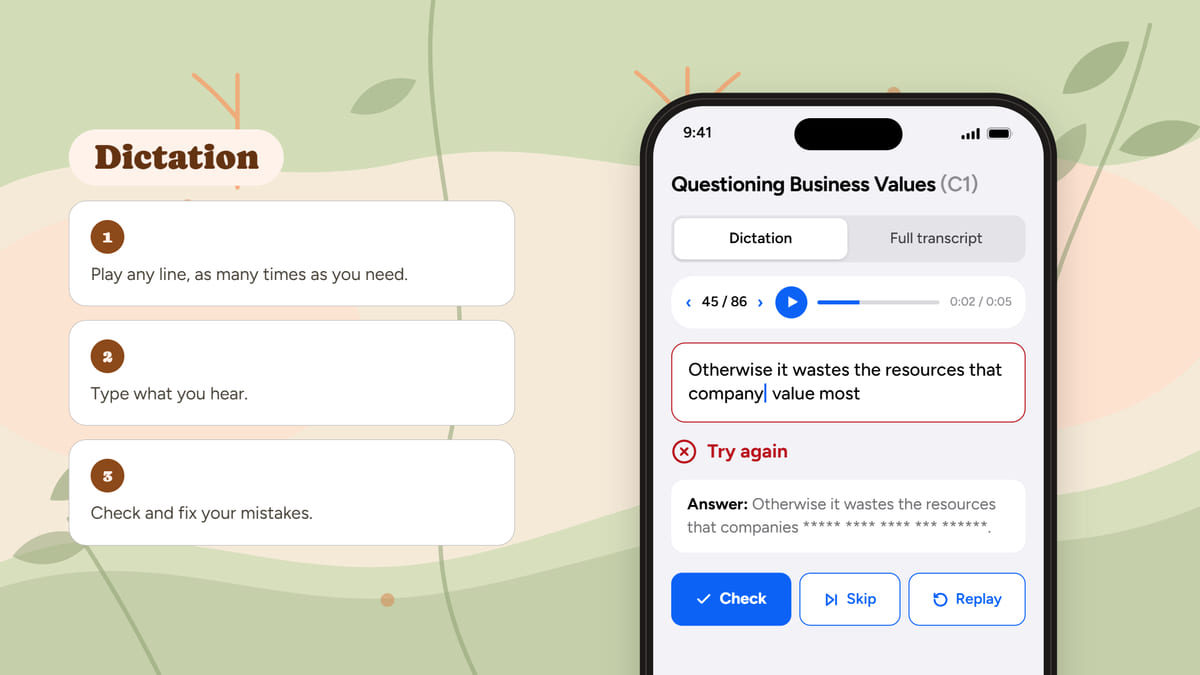
To help you strengthen bottom-up listening, HiBeaver breaks each recording into individual sentences so you can train your ear and catch every single word.
Each practice loop follows four simple steps:
- Listen: Play a short audio clip at your own pace.
- Type: Write down exactly what you hear.
- Check: Compare with the transcript to see if you made any mistakes.
- Replay & Fix: Listen again to hear what you missed, then correct your answer.