

If you’re wondering how to get through all the long passages in IELTS Reading, don’t worry. Learning how to skim and scan will help you speed things up.
These two reading strategies can significantly improve your ability to locate information quickly and understand texts efficiently. Being able to skim and scan will allow you to process large amounts of text in IELTS Reading – in both IELTS Academic and General Training. Whichever IELTS version you’re taking, these strategies will ultimately help you achieve a high band score.
So, how do they work in practice? Below, we’ll break down the difference between skimming and scanning, along with the best ways to apply them during the test.
What is skimming?
Skimming is when you move your eyes quickly over a text to locate the main themes. It helps you get the general idea of the text without reading every word. This is often called the ‘gist’ of the text. The details are not important when skimming. Think of it like a bird soaring high just to get a bird’s-eye view of the landscape.
Why skimming alone is not enough
Skimming works because you leave details out. That makes it useful for building a map, but not for getting the right answer.
In three eye-tracking experiments involving 76 medical students, students spent less time on a first reading and on rereading when they skimmed clinical texts. In two of those experiments, skimming made it harder for readers to process the meaning deeply or link it to their background knowledge.
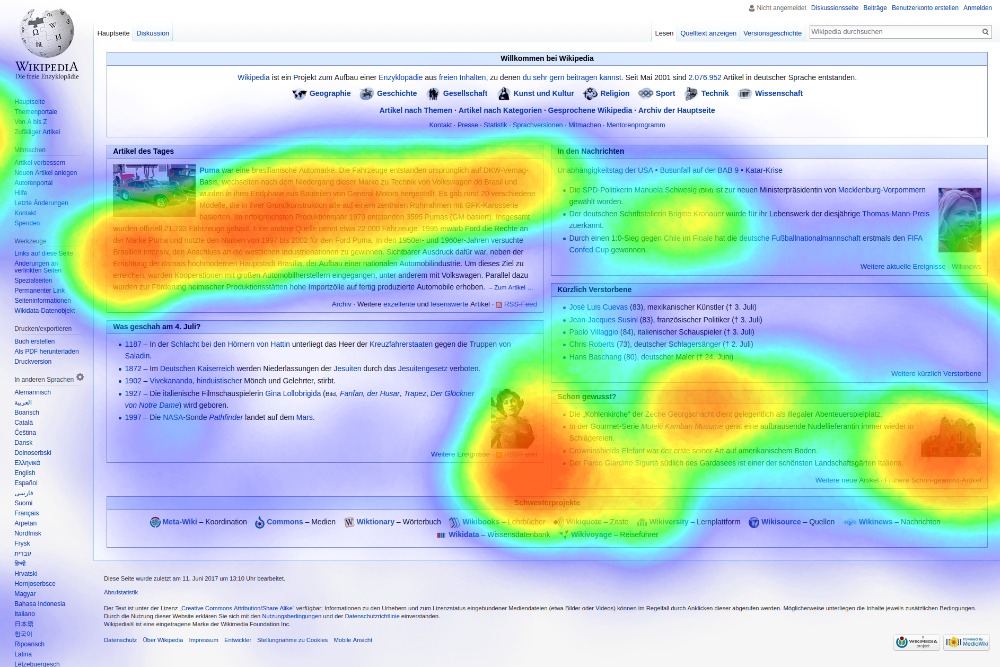

Medical students are not IELTS candidates, so this study cannot prescribe an IELTS strategy. It does show why a quick first read is never enough. Use skimming to choose an area, not to confirm an answer.
So what is scanning?
Scanning, on the other hand, is used to find specific details in a text. Instead of reading everything, you search for keywords, numbers, dates, or particular phrases that answer a given question. Think of it like a bird swooping down to hit a specific target on the ground.
Why are skimming and scanning techniques important for IELTS?
Remember that the IELTS Reading test contains three sections with increasing difficulty. On top of that, you only have 60 minutes to complete 40 questions! This means you will not have time to read every word carefully. Instead, you need to combine skimming and scanning to find answers efficiently.
Skimming and scanning help you:
- Save time by avoiding unnecessary reading
- Improve overall comprehension
- Identify key information quickly
- Increase accuracy in answering different question types
Practise Skim & Scan with HiBeaver
Get the big picture first, then repeat a short loop for every question.
Skim — Build a quick map of the passage before opening the questions.
For each question, repeat this loop:
- Analyse question — Identify what the question asks.
- Scan — Follow your map to look for clues.
- Close Read & Answer — Read the matching area carefully and answer.
HiBeaver is smartly designed to make Skim & Scan practice smooth even on small mobile screens, letting you practise anywhere on the go.
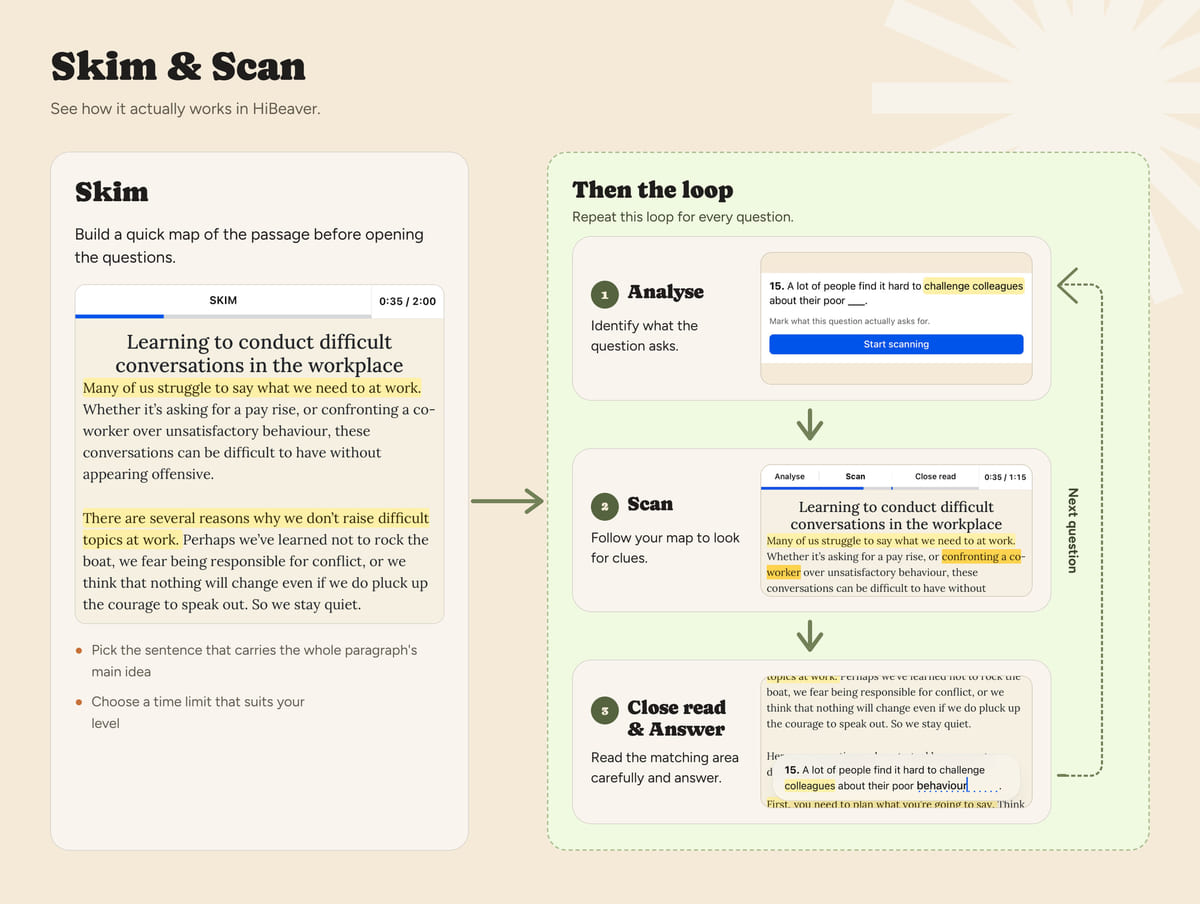
In this example, skimming quickly highlights the main ideas and takeaway. For Question 15, challenge colleagues and poor point towards confronting a co-worker and unsatisfactory behaviour. Scanning locates that sentence; close reading confirms behaviour as the answer.
Sources
- Reading and skimming clinical information — BMC Medical Education.
- Eyetracking heat map Wikipedia — Tschneidr, CC BY-SA 4.0, via Wikimedia Commons.