

There was still a practical problem. Repeating every saved word every day soon becomes tiring. Reviewing words you already know takes time away from the ones that actually need practice. I needed repetition, but I also needed a smarter way to review words at just the right time. That is the job of SM-2.
SM-2, in three questions
What is SM-2?
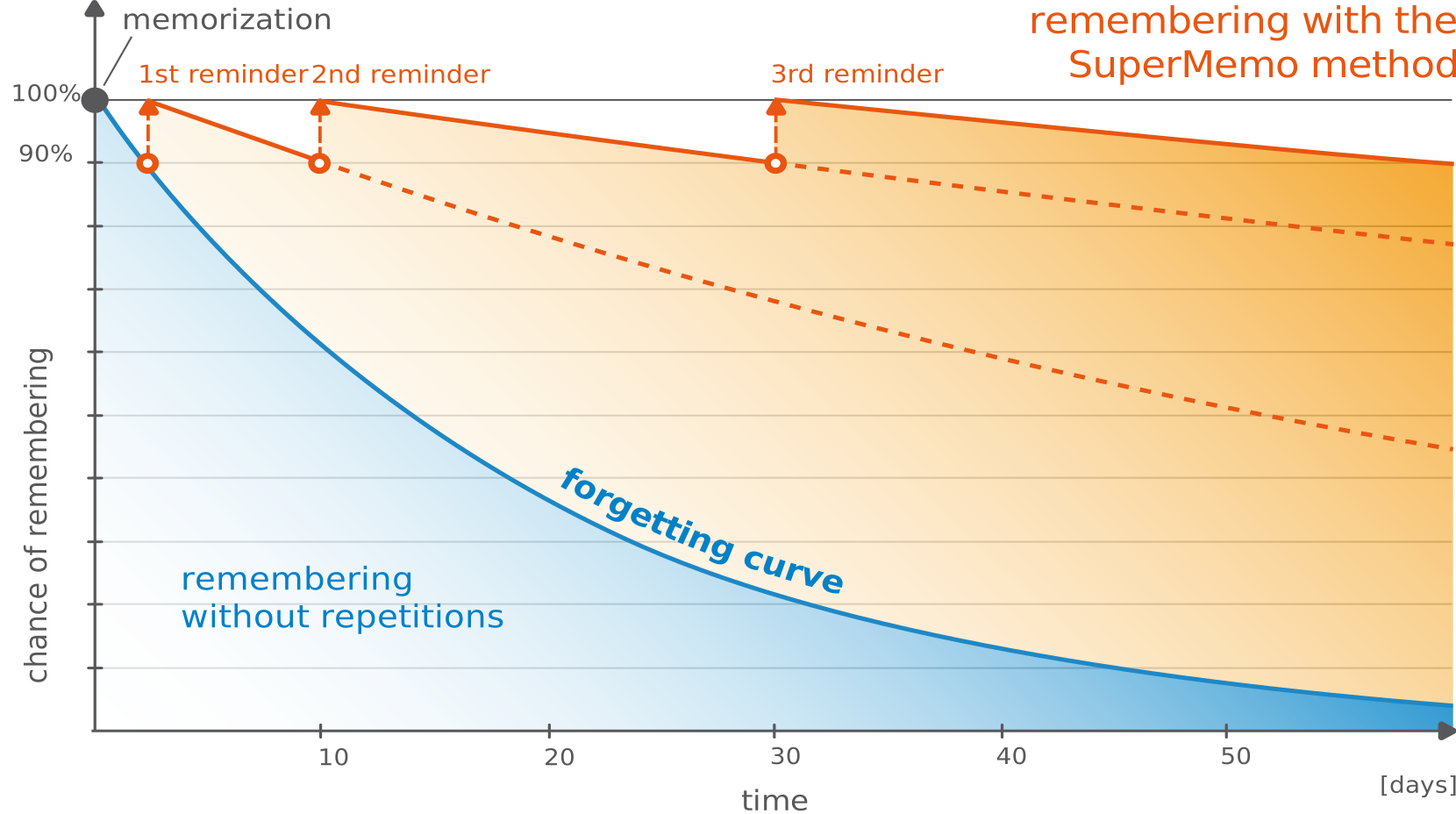
SM-2 was created in the late 1980s by SuperMemo, a pioneer in computer-assisted learning and memory research. At its heart, SM-2 is a spaced repetition algorithm that schedules each review at the perfect moment to prevent forgetting. Today, it remains the standard formula powering nearly every major memory and flashcard platform in the world.
How does it work?
The algorithm relies on two core principles:
- Active Recall: You test your memory first and rate how well you knew the answer.
- Adaptive Intervals: Review gaps expand for easy words and shorten for difficult ones, creating a custom schedule for every card.
Who uses it?
Anki is the best-known open-source flashcard app for long-term retention. It combines active recall with the SM-2 spaced repetition algorithm, automatically scheduling reviews right before you forget, as outlined in its official FAQ. Millions of learners worldwide rely on Anki to remember massive amounts of knowledge.
Memory in HiBeaver
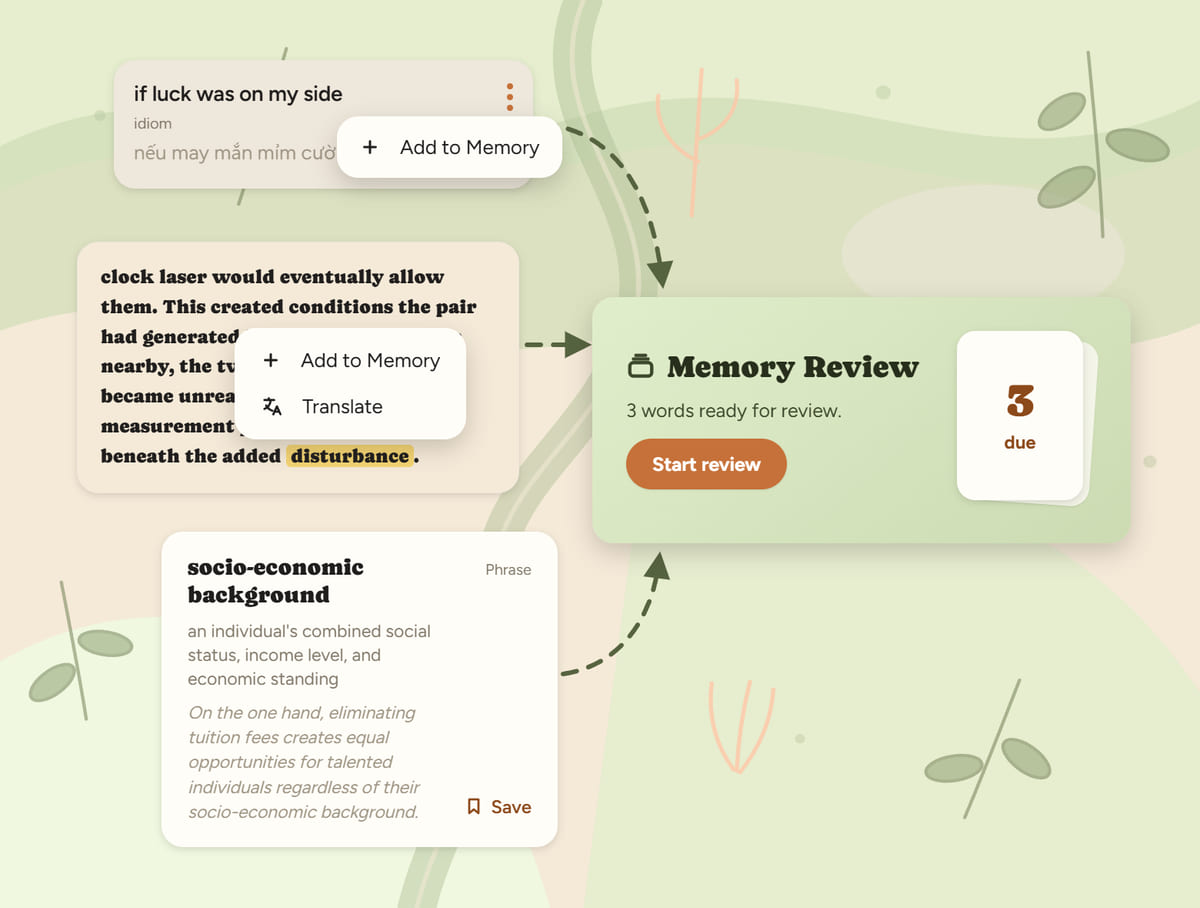
Seeing the vital role of memory in language learning, we developed a feature called Memory. It lets you collect anything you want to remember, wherever you come across it, and practise until it becomes second nature — stored safely in your long-term memory.
To achieve this, we powered Memory with SM-2 — the spaced repetition method introduced above.
A real example in action:
- Discover — While doing Dictation, you hear “raise a concern”. It sounds natural and useful, so you choose to add it to Memory.
- Recall — The next day, HiBeaver schedules a review card, giving you a chance to test your memory before seeing the answer.
- Rate — Select Again if you missed it, or Get it if it came to mind easily.
From there, HiBeaver uses your response to calculate the ideal next review date.
Knowledge truly stays with you when connected to real-life moments. Simply focus on your daily practice — reading, listening, writing, and speaking. HiBeaver takes care of the rest, helping you collect, store, and train your memory effortlessly. We’ve also integrated AI to break down and explain the exact meaning and nuances of any word whenever you need clarity.
Sources
- Application of a computer to improve the results obtained in working with the SuperMemo method — Piotr Wozniak, SuperMemo.
- What spaced repetition algorithm does Anki use? — Anki FAQs.
- SuperMemo — SuperMemo.